The Olde Pink House: A Mansion, a Mystery, and a Matter of Money | Part 2
Last Sunday, we met the Habershams, one of colonial Savannah's most prominent families, and discovered how the American Revolution divided a Loyalist father from his three Patriot sons.
This week, we finally arrive at the house itself.
By the time the Revolutionary War ended in 1783, Savannah had endured years of political upheaval, British occupation, and the devastating Siege of Savannah in 1779.
The city that emerged from the conflict was no longer a British colonial outpost. It was part of a new American republic, and its leading citizens were eager to establish themselves in the society they had helped create.
Among them was James Habersham Jr.
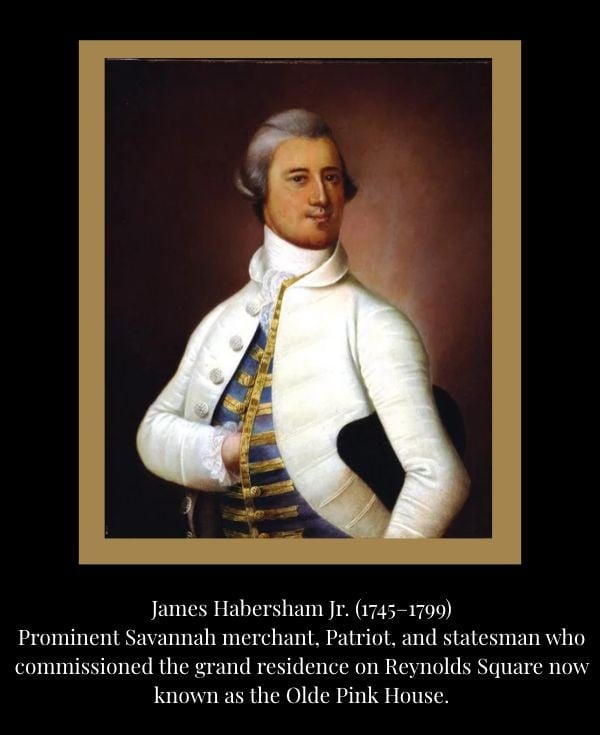
Like his younger brothers, Joseph and John, James Jr. had supported the Patriot cause. He had also established himself as a successful merchant and respected public official, serving in Georgia's legislature and twice holding the position of Speaker of the General Assembly.
In 1785, he was appointed one of the original trustees of the University of Georgia.
He was, in short, a gentleman of considerable standing.
And what better way to demonstrate that standing than with a magnificent residence overlooking one of Savannah's fashionable squares?
But before we admire the house, there is something rather curious about the land upon which it stands.
A Question of Property
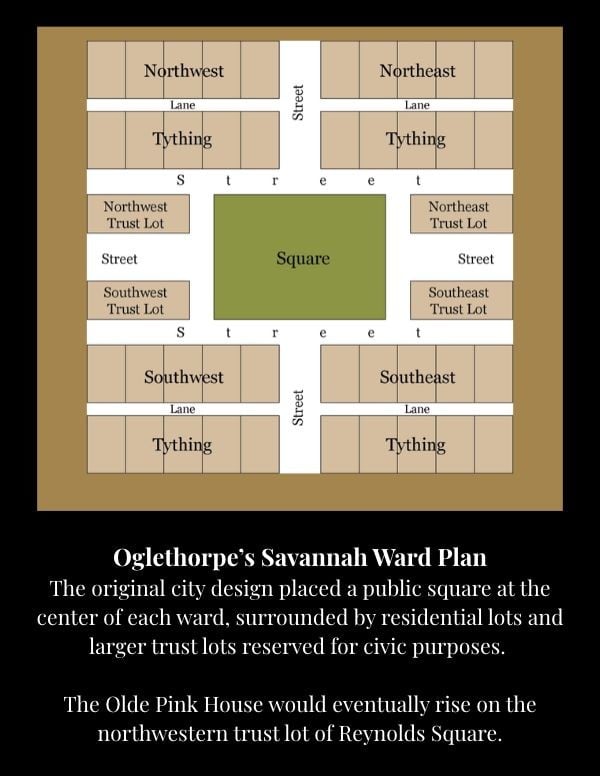
When General James Oglethorpe laid out Savannah in 1733, he established a distinctive system of squares surrounded by residential lots and larger parcels known as trust lots.
Unlike the smaller lots intended for private homes, these larger parcels were reserved for civic and public purposes, including churches, schools, and government buildings.
Indeed, historical records indicate that a public school occupied the northwestern trust lot of Reynolds Square, the future site of the Olde Pink House, in 1756.
Yet just fifteen years later, on September 7, 1771, James Habersham Jr. purchased that very property.
Which raises an interesting question.
How did land originally reserved for the benefit of the community, and occupied by a public school only fifteen years earlier, become available for private ownership?
By 1771, Georgia had been a royal colony for nearly two decades, and many of the original trustees' restrictions had fallen by the wayside. But that doesn't tell us precisely how this particular property passed from public use into private hands.
And there is one other detail worth mentioning.
The very year James Habersham Jr. purchased the lot, his father, James Habersham Sr., was serving as Georgia's acting royal governor.
Was that merely a coincidence? Or might the elder Habersham's considerable political influence have played some part in his son's acquisition of such a desirable property?
We have no evidence establishing a connection, and the historical accounts available to us do not identify the earlier chain of ownership or explain the circumstances of the sale.
Still, one cannot help wondering.
And as it turns out, the acquisition of the property was not the last financial question surrounding the house.
A House Fit for a Gentleman
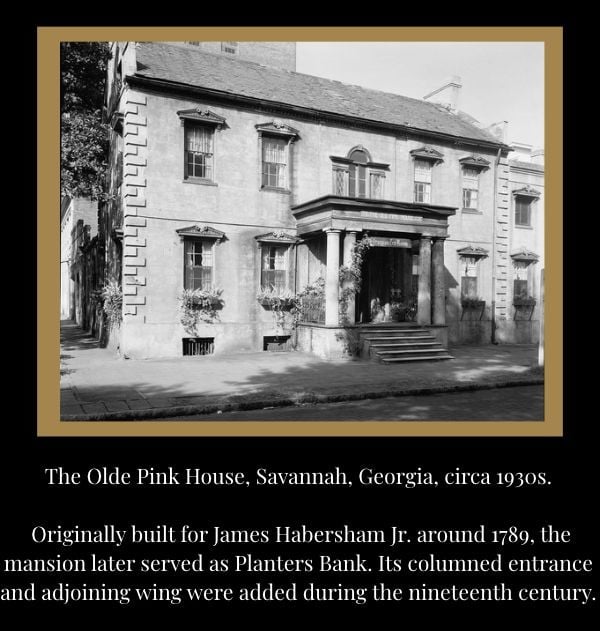
Although Habersham purchased the property in 1771, the grand brick mansion we recognize today was apparently not completed until around 1789.
The distinction matters, because some popular accounts date the house itself to 1771. Historical research, however, indicates that wooden buildings already stood on the lot when Habersham purchased it, and that the brick residence came later.
Either way, the resulting mansion was among Savannah's finest private homes.
Built in the Georgian style, it featured an imposing, symmetrical façade, elegant proportions, and a distinctive Palladian window above the central entrance.
Its prominent position on Reynolds Square was equally impressive.
This was not simply a comfortable family home. It was a residence befitting one of Savannah's most influential citizens.
And yet, behind that handsome façade, another intriguing story was unfolding.
The Cousin, the Construction, and the Courtroom
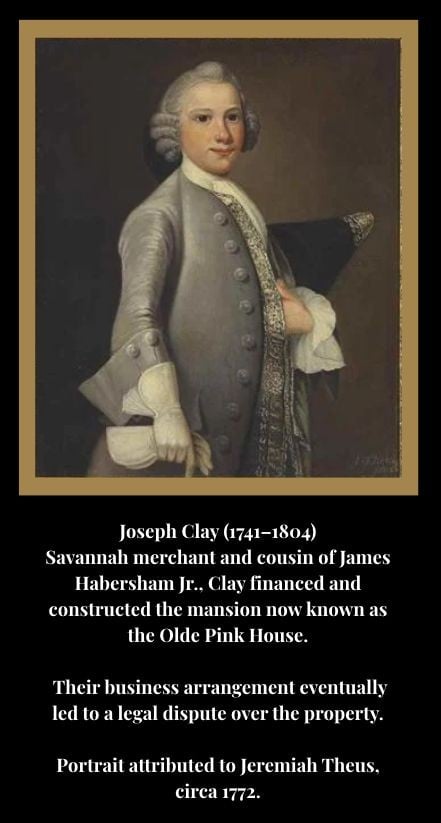
The mansion was built for James Habersham Jr., but the man who financed and constructed it was his cousin and former business associate, Joseph Clay.
Now, there was nothing particularly unusual about relatives entering into financial arrangements in eighteenth-century Savannah. Family relationships and commercial partnerships frequently overlapped.
But this arrangement apparently became considerably more complicated.
According to historical research referencing Chatham County Superior Court records, Joseph Clay took legal action involving the property in 1789, the very year generally associated with the mansion's completion.
An older architectural account reports that Clay levied against the eastern half of the lot and the brick house itself.
Which suggests that the magnificent new residence may have been accompanied by a rather substantial financial problem.
Had Habersham undertaken a construction project beyond his available means?
Was his wealth tied up in other investments, leaving him temporarily short of funds?
Or had two experienced merchants, who also happened to be cousins, simply disagreed over the terms of a business arrangement?
The surviving historical summaries don't give us a complete explanation.
And without examining the original court proceedings, we cannot say exactly how the dispute was resolved.
But I find the situation fascinating.
Here was a man from one of Georgia's wealthiest and most influential families, building a residence intended to reflect his considerable social standing, while his own cousin pursued a legal claim against the property.
One wonders what conversations took place around the family dinner table.
Or whether Joseph Clay was still invited.
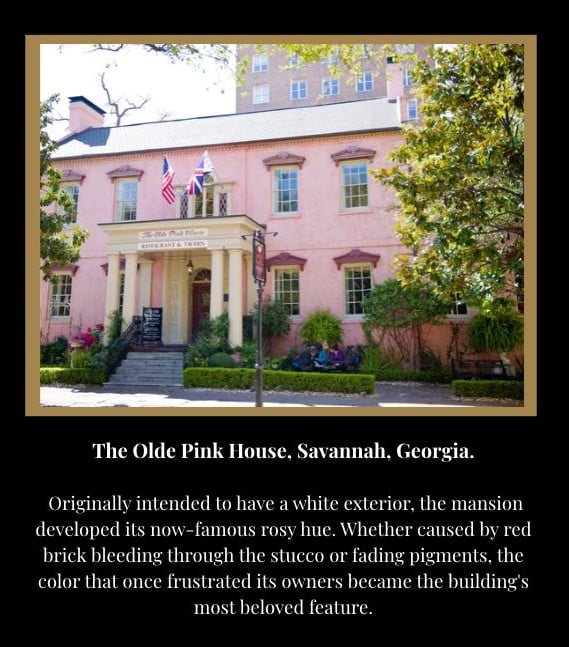
The House That Refused to Stay White
Of course, no account of the Olde Pink House would be complete without addressing the question everyone eventually asks.
Why is it pink?
The house was not originally intended to wear its now-famous rosy complexion.
According to the most familiar Savannah legend, the red brick beneath the white stucco gradually stained the plaster, giving the exterior an unmistakable pink tint.
Successive owners supposedly attempted to conceal the color beneath fresh coats of white paint, only to have the pink reappear.
One can imagine the frustration.
You commission an elegant mansion to demonstrate your prosperity and good taste, only to discover that the building has developed an entirely independent opinion about its appearance.
There is, however, another possible explanation.
Architectural historians have suggested that the color may have originated from a reddish pigment known as Spanish brown, applied to the stucco and faded over time.
The precise origin of the pink remains uncertain. What is certain is that the distinctive color eventually became the building's most recognizable feature.
The house that was never intended to be pink became one of Savannah's most famous landmarks.
A Family's Departure
James Habersham Jr. died in 1799, approximately ten years after the mansion's completion.
Three years later, in 1802, his widow sold the property, bringing the Habersham family's ownership to an end.
Why did she sell?
Was it simply the practical decision of a widow who no longer needed such a substantial residence? Was the property too expensive to maintain? Or did the earlier financial difficulties surrounding its construction have some bearing on the decision?
We don't know.
And while it would be tempting to connect the sale to Joseph Clay's earlier legal action, the available historical accounts do not establish such a relationship.
For a time, the mansion continued to serve as a private residence.
But Savannah was changing.
Its growing importance as a commercial port brought new wealth, new businesses, and an increasing need for financial institutions.
In 1812, the former Habersham residence became the home of Planters Bank of Georgia, the state's first chartered bank.
The building underwent substantial alterations, including the addition of a northern wing and, in the years that followed, the handsome Doric portico that remains one of its most recognizable architectural features.
And there is a certain irony in the transformation.
A house whose early history included a legal dispute over money had become a place devoted to managing everyone else's.
But the Olde Pink House was only beginning its remarkable journey through Savannah's history.
Wars, changing fortunes, and even the threat of demolition still lay ahead.
And fortunately for us, the old mansion would survive them all.
Next Sunday: From banking house to historic landmark, we follow the Olde Pink House through war, decline, and the determined efforts of those who refused to let one of Savannah's architectural treasures disappear.
Savannah Secrets | The Olde Pink House
A Four-Part Historical Series
Part 1: A Savannah Family Divided by Revolution
Part 2: A Mansion, a Mystery, and a Matter of Money
Part 3: From Bank Vaults to Ballroom Fires
Part 4: Ghost Stories and Savannah Legends